
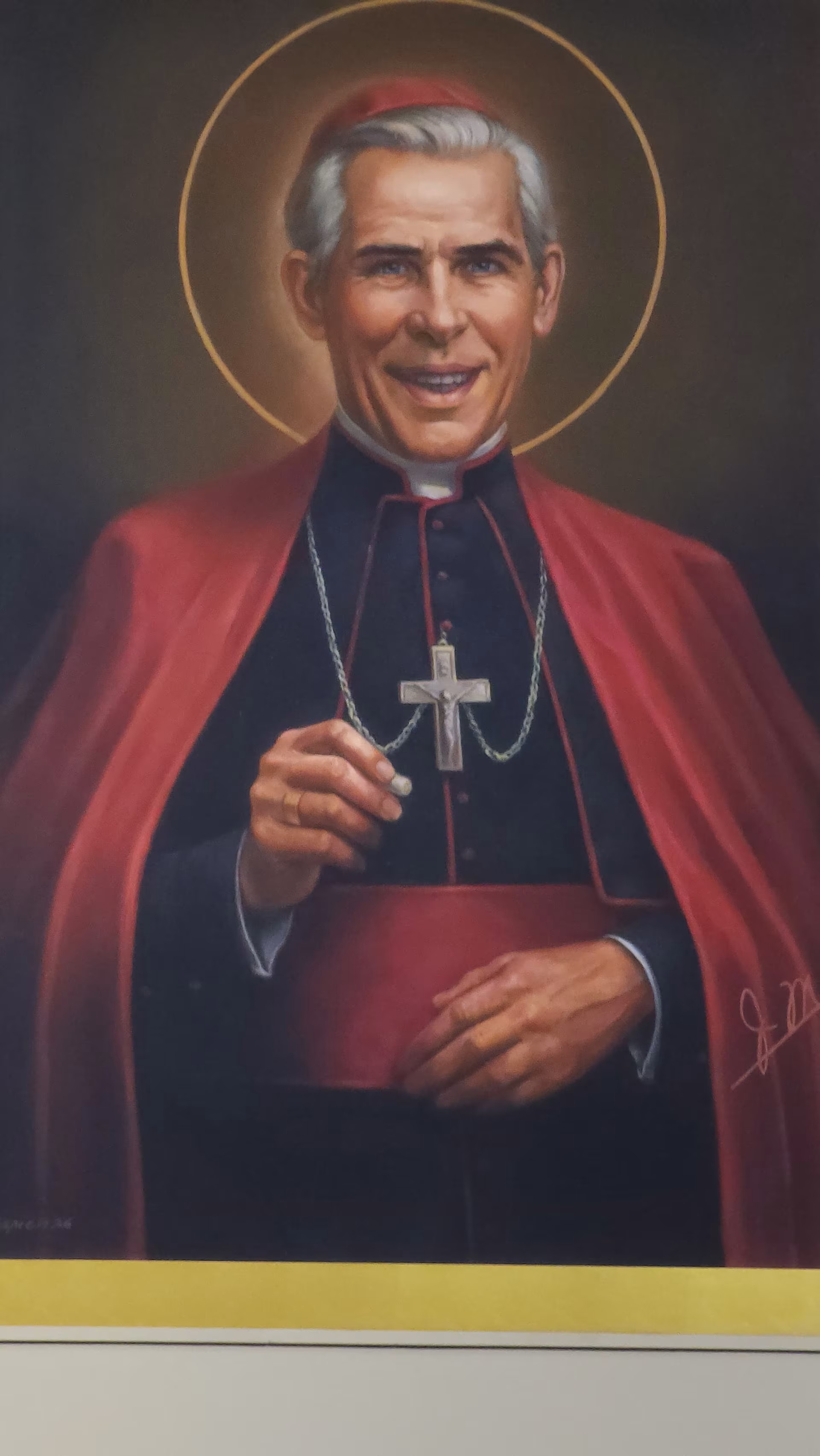
As a Filipino immigrant growing up in the United States, I often came across Archbishop Fulton J. Sheen’s old television broadcasts on EWTN. Even in brief clips, his measured voice, direct gaze, and simple chalkboard drew me in. Now, as a Catholic writer, I admire the clarity and conviction with which he shared the faith.
It was especially meaningful to see Cardinal Luis Antonio Tagle preside at Sheen’s beatification Mass in St. Louis as Pope Leo XIV’s representative. As a Filipino Catholic, this was an extra personal connection to the celebration. Tagle’s homily also spoke to my work as a writer—and to today’s podcasters and video creators: the life behind our message matters as much as the number of people it reaches.
Tagle described Sheen as a preacher of the Gospel and a missionary shepherd. Sheen reached millions through radio and television, but the size of his audience, his popularity, and the reach of his broadcasts were not what made him blessed. Tagle pointed instead to his communion with Jesus and his closeness to people, especially those who were poor and vulnerable.
One story captures Sheen’s attitude toward his work. When Pope Pius XII asked how many people he had converted, Sheen said he had never counted them. He feared he might begin to think the conversions were his own achievement. He saw himself as a porter who could lead people to the open door of God’s house.
That image stays with me in an age when creators can check their views, followers, and shares at any moment. Those numbers can show us how far a message has traveled. They cannot tell us everything that happens in a person’s heart.
Behind Sheen’s public ministry was a daily Holy Hour before the Blessed Sacrament, a commitment he kept throughout his priesthood. Prayer was central to his life and work. He made time to be with Jesus as he devoted his gifts to speaking about him.
For those of us who create Catholic content, Sheen’s example suggests a useful pause before we write, record, or turn on a camera. The pressure to publish regularly can push prayer to the end of the day. We can instead spend time before the Blessed Sacrament, reflect on the Gospel, or ask whether what we are about to share is faithful, truthful, and offered with love. We may not all be able to keep Sheen’s daily Holy Hour, but we can let prayer shape the work before it reaches an audience.
Sheen’s missionary calling extended beyond his broadcasts. From 1950 to 1966, he led the Society for the Propagation of the Faith in the United States. He encouraged Catholics to support missions around the world and visited communities where the Church was growing. He also created the World Mission Rosary, inviting people to pray for different regions, including Asia.
For many Filipino Catholic families, the Rosary is a familiar way to bring loved ones’ needs into prayer. Sheen’s World Mission Rosary widens that circle. It reminds content creators that media can help people learn about and care for communities beyond their own.
Tagle’s homily brought that concern down to the level of a single encounter. He recalled Sheen’s visit to a center for people affected by leprosy in Uganda. Sheen had brought silver crosses to give them, but recoiled when he saw one man’s injured arm. He recognized the contradiction in offering a sign of Christ while drawing away from someone who suffered. Overcoming his fear, Sheen touched and held the man’s arm. Tagle presented the encounter as one that changed Sheen himself.
A camera can bring distant suffering into view, but it can also allow us to scroll quickly to the next story. Sheen’s experience asks whether we give people more than a passing moment of attention—and whether we allow their lives to affect our own.
Seeing Cardinal Tagle at the beatification was a joyful moment for me as a Filipino Catholic who finds joy in sharing the faith. His homily also left me with a question for my writing: Have I spent enough time listening in prayer before I speak? Sheen’s life offers a rhythm worth learning: pray, pay attention to people, and use the gifts and media available to help others draw closer to Christ.
Contributor:
BJ Gonzalvo, Ph.D., is a psychology researcher whose focus is on retracing the indigenous roots of his core value of kapwa to help reframe and rediscover the sacredness of our interconnectedness. His writing, where he often integrates culture, psychology, and spirituality, has appeared in Northwest Catholic, Busted Halo, FilCatholic, and Mind & Spirit. He is the author of several books including Lead Like the Saints, Gift of Kapwa, and Music: The Art of Togetherness